
Not every product journey begins with a plan. Sometimes it begins with a wall full of sticky notes and a mild sense of panic.
Recently, I challenged myself to generate 99 product ideas—an unfiltered download of every tool, workshop, micro-learning, dashboard, simulation, and strategic model I’ve ever thought might be valuable to the world. And I did it. All 99, captured and posted on a wall.
It should have felt like progress. Instead, it felt like chaos.
Looking at the wall was overwhelming. It wasn’t a portfolio—it was a tangle. An undifferentiated mass of inspiration that made it hard to know where to begin. That’s when I did what any product manager instinctively does when faced with complexity: I started organizing.
Step One: Sort for Signal
As I scanned the ideas, patterns emerged. There were clusters of simulations and games. Others grouped around strategic tools, dashboards, mapping techniques, and operating models. These themes weren’t random—they reflected who I am as a creator and strategist. They were unique to my point of view, and that mattered.
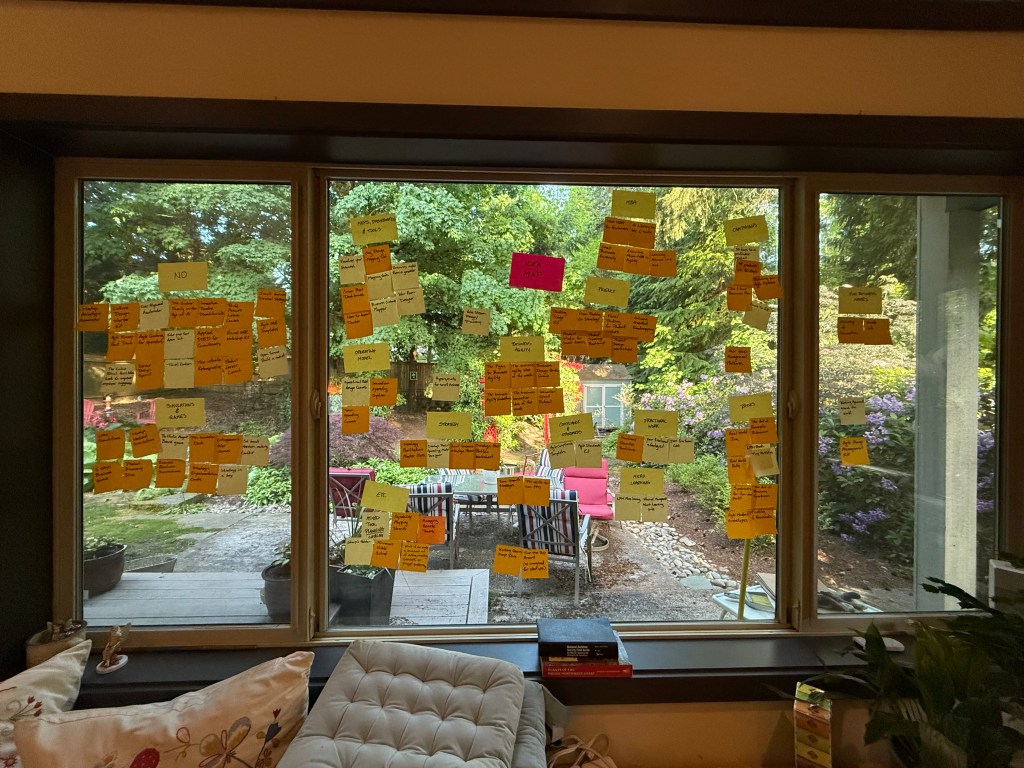
But there were also ideas that… didn’t hold up. In the cold light of day, some concepts felt uninspired, impractical, or just not me. And that’s okay.
Those ideas went into what I’ve affectionately labeled the “No” Category—a sort of intellectual compost heap for concepts that either don’t align with my goals or no longer spark energy. About 18 or 19 ideas landed there, and I let them go with gratitude.
Step Two: Discover Emerging Themes
What remained was no longer noise. By sorting and pruning, I uncovered early-stage product clusters—each one with potential to evolve into a focused roadmap. These weren’t just isolated ideas anymore; they were ecosystems of value.
And that’s the shift: When you take a messy backlog and start shaping it with intention, you begin to see a path. A product direction. A strategy.
Step Three: Evolve into Roadmaps
My next step? To turn each of these thematic clusters into viable product concepts, with roadmaps that support iteration and market relevance. These collections—now coherent and connected—offer a practical foundation for building out a portfolio, not just a one-off product.
Each idea has the potential to grow into something meaningful. Some are stepping stones. Others may become platforms. But now, they’re more than thoughts—they’re potential.
Key Takeaways for Product Dreamers:
Ideation isn’t always inspiring at first—it’s often intimidating. That’s normal.
Categorization is a powerful tool to surface patterns and uncover what truly resonates with your vision.
Letting go of weak ideas is not failure—it’s product sense.
Clusters of related ideas can become the seeds of future roadmaps.
In product management, clarity rarely comes all at once. It’s uncovered layer by layer, decision by decision. What started as chaos has now become the beginning of a strategy.
The adventure continues.
 The 99 Product Challenge
Leave a comment