It’s only Day 3, but momentum is already building fast—and with it, the need to turn creative energy into concrete results. I’ve gone from brainstorming mode into the early stages of execution, and I want to share what that transition looks like in real time.
Herding the Ideas (and Getting a Little Overwhelmed)
So far, we’ve built a solid list of product ideas—99 of them, in fact. That raw creative surge has now been channeled into categories that (at least in my mind) make sense: games, simulations, dashboards, models, visualizations, and a handful of wildcards.
But here’s the challenge: What comes next?
This is the moment where the rubber hits the road. It’s time to move from “that’s a cool idea” to “let’s test this thing.” And that means getting some of these ideas into motion immediately.
Kanban Meets Chaos
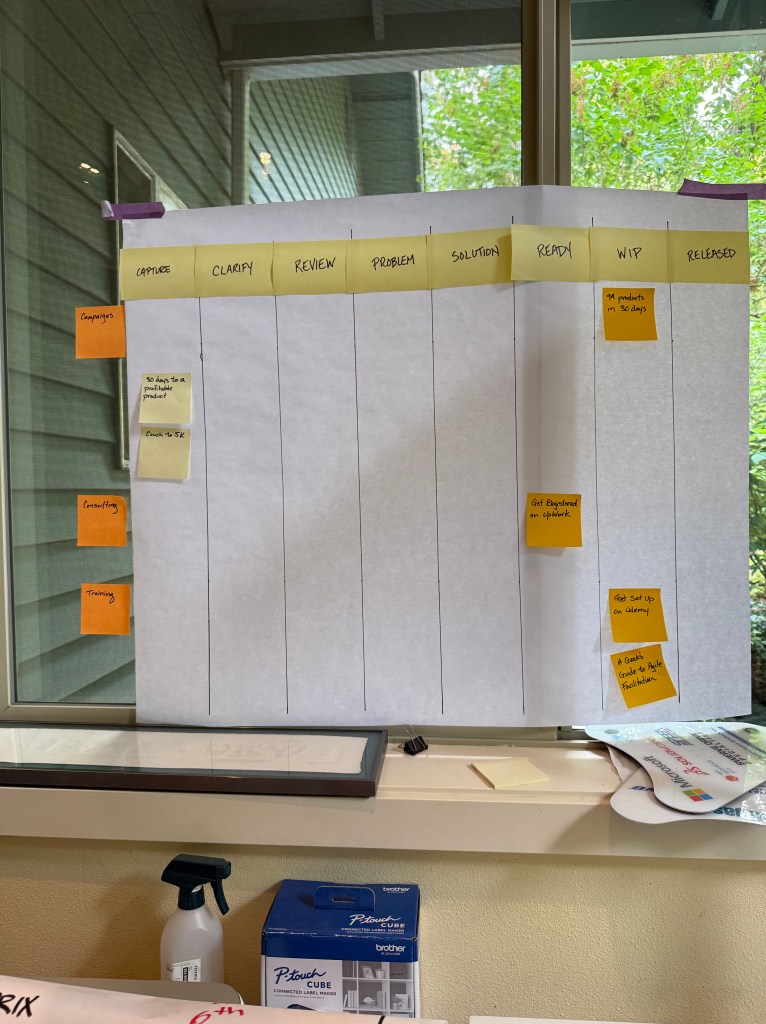
To start tracking execution, I turned to a Kanban board. But let’s be honest—when you’re running solo and moving quickly, even a Kanban board can feel like a bottleneck. I’ve been experimenting with multiple ideas across several domains at once, and that’s created a level of complexity that’s hard to capture with a single linear board.
The solution? Swimlanes. I reorganized the board to reflect different tracks of work—essentially creating parallel streams for distinct areas of experimentation. That’s helped clarify where I’m focusing, even if it still feels like a sprint in five directions at once.
MVPs in Motion
Behind the scenes, I’ve begun spinning up tiny MVPs and pilot experiments. These are early, scrappy versions of the product ideas—just enough to test basic assumptions and gather signals about what has potential.
I’ll share more about these pilots as they evolve, but suffice to say: it’s a fast-moving, failure-friendly environment. Not every idea will make it out alive. That’s part of the point.
The Limits of Rigid Workflow
One thing I’ve realized is that rigid process frameworks don’t always serve creative work at speed. Kanban is great for visualizing workflow and limiting work in progress, but innovation is messy. It doesn’t always move in straight lines. Sometimes it’s two steps forward, one step sideways, and then a leap off the map entirely.
Right now, my work feels less like a linear production line and more like an evolving constellation of ideas. Maybe I need a different kind of visual tool—a network diagram, a mind map, something nonlinear that reflects how real-world innovation actually happens when you’re moving fast and solo.
The Goal: A Handful of Real Products
So what am I aiming to achieve by the end of this 30-day sprint?
Let’s be realistic. All 99 ideas won’t become products. Some will be abandoned. Some will stall. Some, I hope, will spark.
The real goal is this: to have half a dozen to a dozen simple, functioning products—real offerings that can live (and maybe even thrive) in the wild. If I can point to 6–12 things that customers can actually buy, even at a small scale, I’ll consider that a massive win.
Because for all the fun and chaos of the early stages, the dream is to ship. To move from ideas to experiments to products—and maybe even to revenue.
That’s the journey. That’s the bet. And we’re only getting started.
 The 99 Product Challenge
Leave a comment