

Drowning in Admin: The Hidden Cost of Innovation
Let’s be honest—one of the hardest parts of working on new product ideas isn’t coming up with the ideas themselves. It’s the avalanche of administrative tasks that come with trying to bring those ideas to life. On Day Four of this particular product journey, I found myself buried in the bureaucratic swamp: filling out forms, registering for new accounts, jumping through digital hoops just to participate in the work I’m trying to create.
It’s tedious. It’s boring. And worst of all—it’s necessary.
You can’t ignore these tasks. They’re part of the scaffolding that holds the whole operation together. But let’s call it what it is: innovation often starts with yak shaving. That’s the tongue-in-cheek term for all those menial, prerequisite tasks you have to complete just to get to the thing you actually want to work on. If you’ve ever thought “I need a personal admin just to keep up,” you’re not alone.
The Admin Work
Is the Innovation Work
Here’s the twist: those boring tasks aren’t a detour. They’re an essential part of the road.
This realization is a tough pill to swallow for many product folks. We got into this game for creativity, not compliance. But chasing down documentation and setting up systems are just as much a part of the innovation process as sketching wireframes or conducting user interviews. It’s all connected. The challenge is keeping the operational overhead from stalling momentum and draining your creative energy.
The key is to plan for it, expect it, and find ways to contain it—without pretending it’s optional.
Non-Linear by Nature: The Myth of Sequential Innovation
Another truth hit home today: product development is not a linear process.
We love clean diagrams and simple roadmaps. They make us feel like we’re in control. But real innovation rarely behaves that way. It’s chaotic, full of overlaps and false starts, and often looks more like a tangle than a timeline.
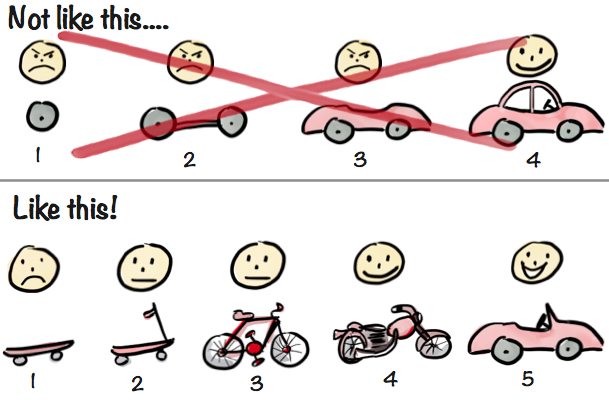
Take Henrik Kniberg’s famous cartoon, for instance: the product evolves from a skateboard to a scooter to a bike, then a motorcycle, and finally a car. It’s meant to illustrate MVP thinking—start small, evolve gradually.
But let’s be real. Before someone builds a skateboard, they’ve probably already experienced the Ferrari.
They’ve used the final product (or something close to it). They’ve fallen in love with the end state. So their MVP journey isn’t born in a vacuum—it’s a constant ping-pong between what exists and what could exist. It’s back and forth between aspiration and iteration. We start with an idea of the Ferrari and try to build a skateboard that even vaguely resembles the thrill.
Parallel Paths, Not Stepping Stones
If I could redraw that cartoon, I wouldn’t show one product morphing into another in a neat sequence. I’d show all those prototypes—the skateboard, the bike, the motorcycle, the car—being developed in parallel. Because that’s what real-world development looks like.
It’s not a staircase. It’s a workshop floor full of competing concepts, overlapping bets, and conflicting inspirations. It’s messy. And it should be.
Embracing the Chaos
If you’re the kind of person who needs a tidy desk and a clean inbox to think straight, product development might not be your happy place.
Because this work isn’t tidy. It’s chaotic. It’s overlapping. And it’s wonderfully nonlinear.
As John Cutler puts it: product development is a beautiful mess. It’s a trainwreck of ideas colliding, merging, evolving. It’s where strategic clarity meets operational reality—and it’s where the magic happens.
So yes, today was full of admin tasks. But it was also full of learning. Because part of the job is managing the mess—without losing sight of the art.
 The 99 Product Challenge
Leave a comment