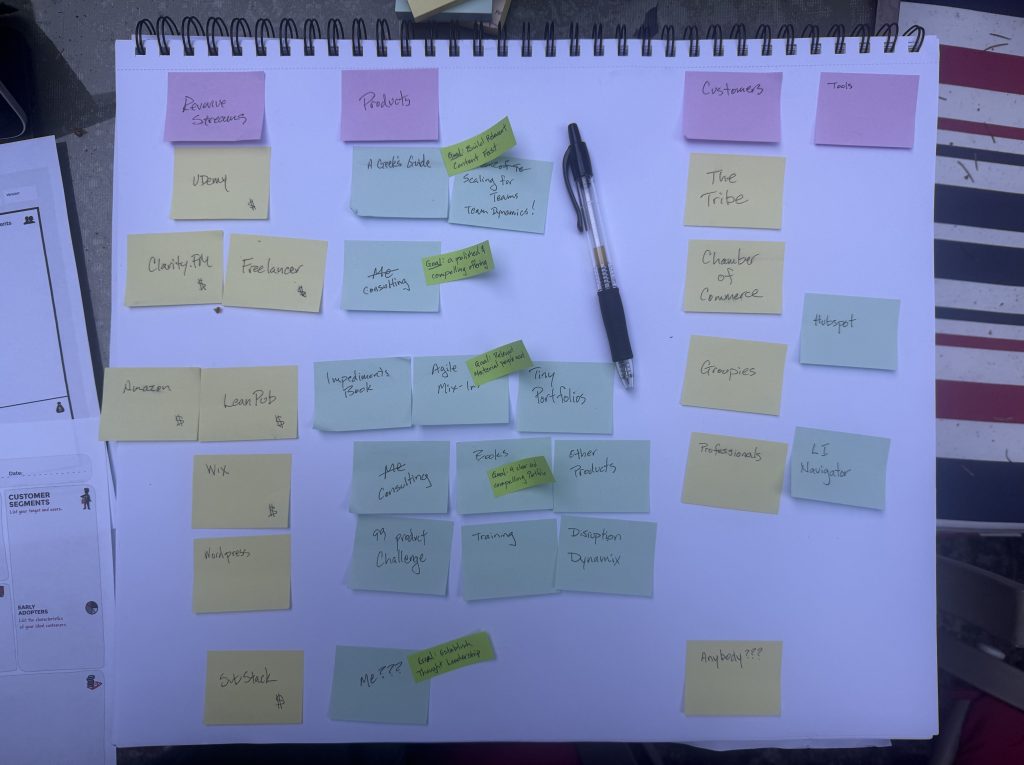
Over the past few days, I’ve been laying out all the products I’m currently working on—about 12 or 13 in total—and trying to get a clearer picture of how everything fits together. What started as a simple inventory exercise quickly turned into something more enlightening: a deep dive into the ecosystem that surrounds every product I create.
Products vs. Revenue Streams
As I began cataloging, I noticed something curious: some entries weren’t actually products—they were channels or platforms. For example, I initially listed “Udemy” as one of my products. But Udemy isn’t the product. The actual product is “The Geek’s Guide to Facilitation”, a short online learning class I created. Udemy is simply a revenue stream—a way to deliver and monetize the product.
That insight led me to split my list into two key categories:
- The actual products I’ve built
- The revenue streams or platforms that enable them to reach and serve customers
Understanding Your Customers
Once I had a clearer picture of products and revenue, I turned my attention to another critical part of the equation: customers. And here too, I noticed important distinctions. Not all customers are created equal, and not all serve the same purpose at the same stage.
1. The Tribe
These are your ride-or-die supporters—friends, family, and closest peers. I could write the world’s silliest book, and these folks would smile and give it a look. They matter not because they’re a huge market, but because they provide encouragement, feedback, and emotional safety.
2. The Groupies
This is the broader circle of former colleagues, past clients, and friendly professional connections. They may not be as deeply invested as the Tribe, but they know who I am, and they’re willing to check out a product—at least once.
3. The Local Network
These are the people I don’t yet know but want to reach—local businesses, small firms, solo entrepreneurs. My local Chamber of Commerce and professional meetups are gateways to building these relationships.
4. The Professionals
This audience finds me through LinkedIn, referrals, and professional associations. They don’t know me personally but are actively seeking services I provide. These are the clients most likely to convert if I reach them with the right message.
Tools That Make It Possible
Then there’s the often-overlooked infrastructure: tools.
Tools like HubSpot, LinkedIn Navigator, and even a good spreadsheet are vital for managing relationships, tracking outreach, and staying organized.
As an introvert, I’m terrible at remembering to write down names or keep detailed contact notes. But if you want to build a real business, you need a system for managing touchpoints—who you talked to, when, what you discussed, and how often. Without that, your marketing becomes noise.
Seeing the Bigger Picture

When I zoomed out, I saw patterns forming. I had instinctively started capturing the same categories you’d find in a Lean Canvas or Business Model Canvas:
- Products
- Revenue Streams
- Customers
- Channels
- Tools
This is the framework that will guide how I think about each product going forward.
Goals: The Missing Ingredient
As I stepped back, I noticed one more important layer: goals.
Each product needs a purpose to thrive:
- My online training products must deliver valuable content fast.
- My consulting offerings need to be polished and compelling.
- My books must be relevant and timely.
The goals are different, but they are all essential for the product’s success. And those goals only become clear when you look at the product in context—not as an isolated idea, but as part of a living system.
Building a Product Ecosystem
That’s the real takeaway. Products don’t live in isolation.
They exist in a network of tools, services, platforms, and people—a product ecosystem. And building a successful business isn’t just about having great ideas. It’s about tending to that ecosystem, piece by piece.
What’s next for me?
I’m moving this thinking into a Lean Canvas for each product—so I can examine them in more detail, test assumptions, and ultimately build something sustainable.
 The 99 Product Challenge
Leave a comment