
No, seriously, I do. A friend of mine looked at my 99 Products blog and said, “That’s cool—but 99 Problems would be way more interesting.” And they were right.
You’ve probably heard the startup mantra: “Find a painful problem and solve it.” It sounds simple enough. But in practice? It’s not so straightforward.

Why Finding Problems Is So Hard
The challenge is that when you talk to people, they often describe one of two things:
- A problem you can’t realistically solve, or
- Something that sounds like a problem but really isn’t.
Why is that? Because people are messy. Feedback is fuzzy. Language is ambiguous. And many of our business systems are fundamentally broken. So you end up sifting through half-baked complaints and vague hopes, trying to figure out what someone’s actual problem is.
My 4 Approaches to Understanding Real Problems
To work through that noise, I’ve been experimenting with a few different strategies.
1. Start with Problems I Know I Can Solve
I sat down and articulated a few core problems I already help solve—then translated them into language that (hopefully) resonates with my ideal customers. I’ve been testing these statements with trusted friends and colleagues who have relevant experience.
Here are a few examples of what I’m testing:
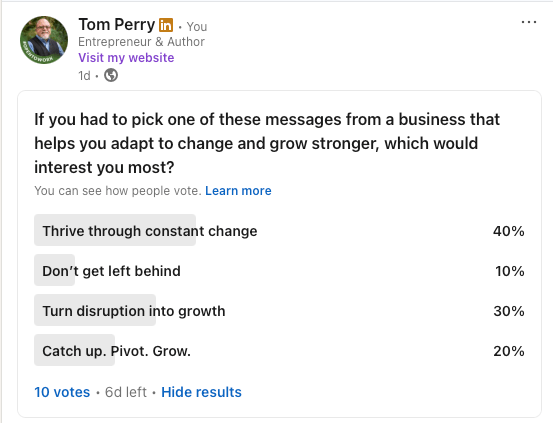
- “We help small business owners facing rapid change adapt their strategy, evolve their products, and build a healthier business—so they can thrive no matter what comes next.”
- “We work with small businesses who refuse to get left behind—using agile strategy, smart training, and co-design to build resilient businesses ready for the modern market.”
- “We turn disruption into an advantage for small businesses by helping them assess risks, reimagine their business models, and lead with clarity in a chaotic world.”
- “When change outpaces your strategy, we help you catch up. Disruption Dynamics offers rapid assessments, practical training, and hands-on support to help small businesses pivot fast and grow stronger.”
I keep track of the feedback and look for which ones get the most nods of agreement or sparks of interest.
2. Use Polls to Scale the Feedback
LinkedIn has become a great testing ground for running lightweight polls. I take the same problem statements and push them out to a broader audience. It gives me a larger sample size and often reveals which words or phrases resonate with people I don’t already know.
3. Talk to Local Business Owners
I’ve also been having one-on-one conversations with local business owners through my Chamber of Commerce. These aren’t just warm fuzzy chats—they’re a chance to test ideas in the wild. Many of these people have built successful businesses through real-world trial and error, and their insights are invaluable.
4. Trust My Own Expertise
At some point I reminded myself: Tom, you’re a seasoned consultant. You’re great at analyzing problems. If I can help my clients uncover and solve thorny challenges, then surely I can take a crack at describing their problems upfront.
So I started writing down the problems I know my clients have—the ones I’ve seen again and again. As the list grew, so did the patterns.
See the list of 99 Problems
Patterns Start to Emerge
With enough problems on the table, common themes begin to show up:
- Some are tech problems.
- Others are people or culture problems.
- Still others are process or strategy issues.
What’s more, this starts to reveal the problem space I’m most comfortable operating in—and the ones I’m not. Let’s face it: I can’t help with every problem under the sun. If you made a Venn diagram of all the world’s problems, the slice I can help solve would be small but mighty.
Using Tools to Analyze the Data
Now that I’ve gathered a hefty amount of data, it’s time to dig in. A few easy tools and techniques come to mind:
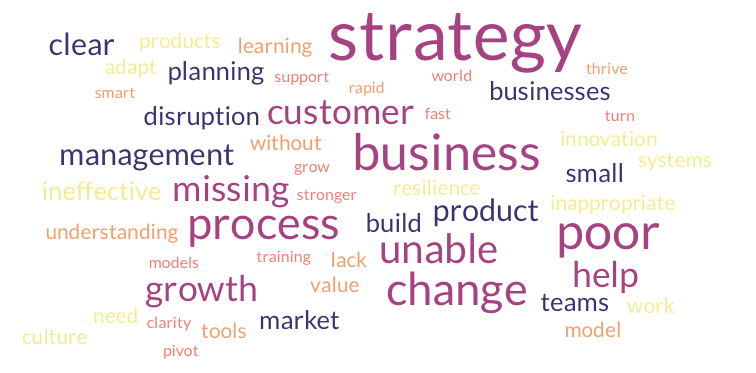
- Word clouds: A simple linguistic analysis could reveal the most commonly used terms.
- AI analysis: Feeding this list into a tool like ChatGPT opens up more sophisticated pattern matching.
Better yet, I could ask the AI to analyze it through specific lenses:
- What would the Jobs To Be Done model say?
- How would Lean Startup classify these problems?
- What insights emerge using Simon Sinek’s Golden Circle?
Each model provides a different lens on what makes a problem meaningful—and solvable.
Mapping Problems Back to Products
Eventually, I’ll want to map these problems back to the 99 products I brainstormed earlier. That loop helps ensure each product is grounded in solving something real.
It’s an iterative process—messy, non-linear, and very human. But that’s the nature of both product discovery and business discovery. You zig. You zag. You go back and forth until things click.
Closing Thought
The journey from 99 Problems to 99 Products isn’t a straight line. But if you’re patient—and willing to listen hard enough—you’ll find the problems that matter most and the products that solve them best.
 The 99 Product Challenge
Leave a comment